
Bitcoin Treasury Adoption: A Strategic Guide for Corporate Leaders



The BitcoinTreasuries.net 2026 Corporate Adoption Guide, produced in partnership with BitGo is now available.
Bitcoin fell 49.8% from its October 2025 peak. Public companies still hold more than 1.26 million BTC — and the preferred-share instruments funding them just passed their first real stress test. Here are five takeaways from our new report.
We are publishing it from an unusual vantage point. Bitcoin peaked at $126,200 on 6 October 2025 and traded at $63,408 on 28 July 2026 — a decline of 49.8%. Roughly half of all public bitcoin treasury companies fell below 1.0x mNAV over that period, and several liquidated outright. Our starting position: a treasury strategy that only works in a bull market is not a strategy — it is a trade.
The full guide walks corporate leaders through why cash is eroding, how to build and govern a bitcoin allocation, and how to secure it.
Preview five key findings below.
1. Corporate cash is quietly losing value
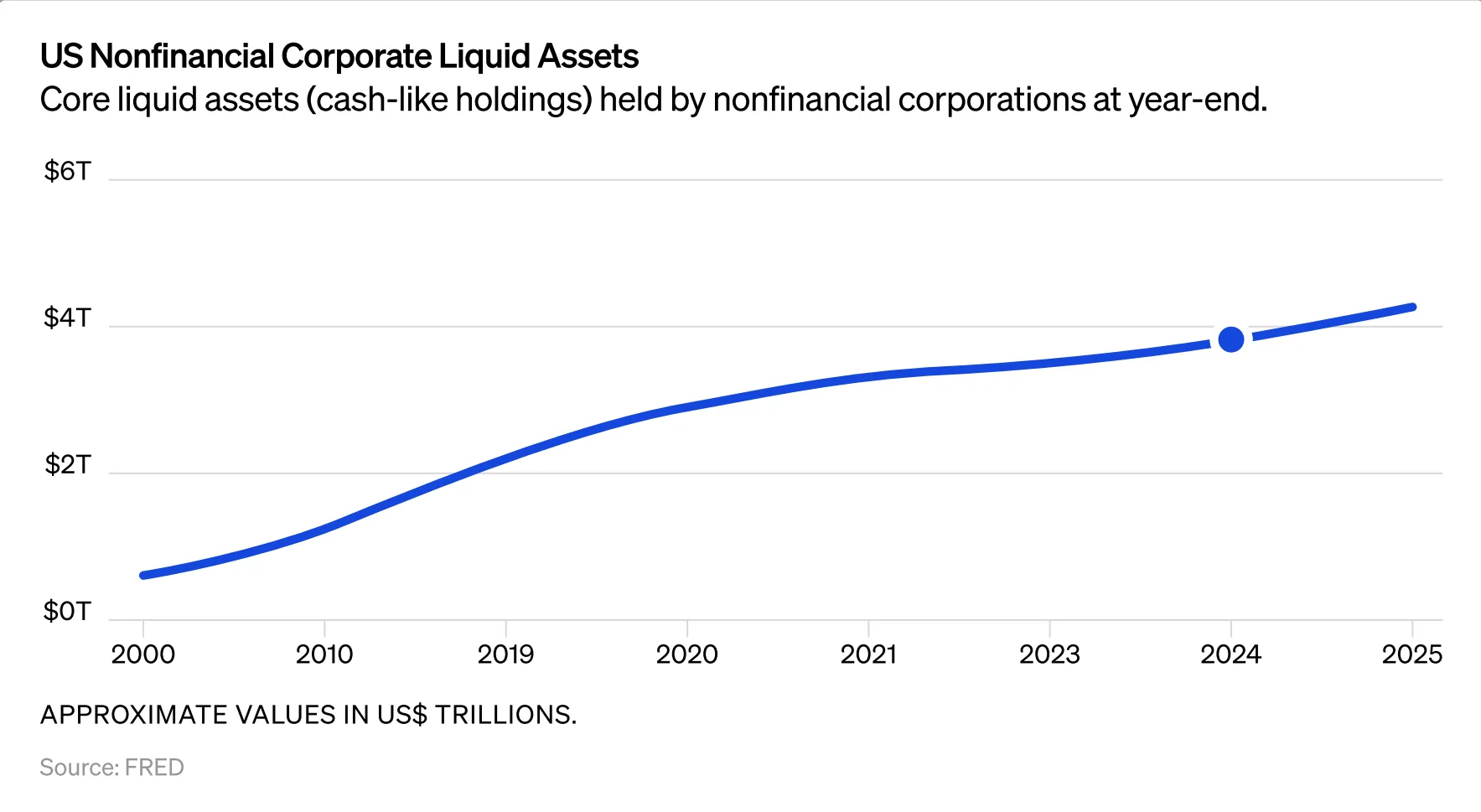
By 2025, U.S. corporations held well over $4 trillion in liquid assets — and against a money supply compounding near 6% a year, nearly all of it is losing purchasing power. A decades-long shift toward income-statement performance left balance sheets thin just as debt approached $40 trillion, rates hit multi-year highs, and geopolitical risk intensified.
2. Every conventional reserve asset lost to the money supply
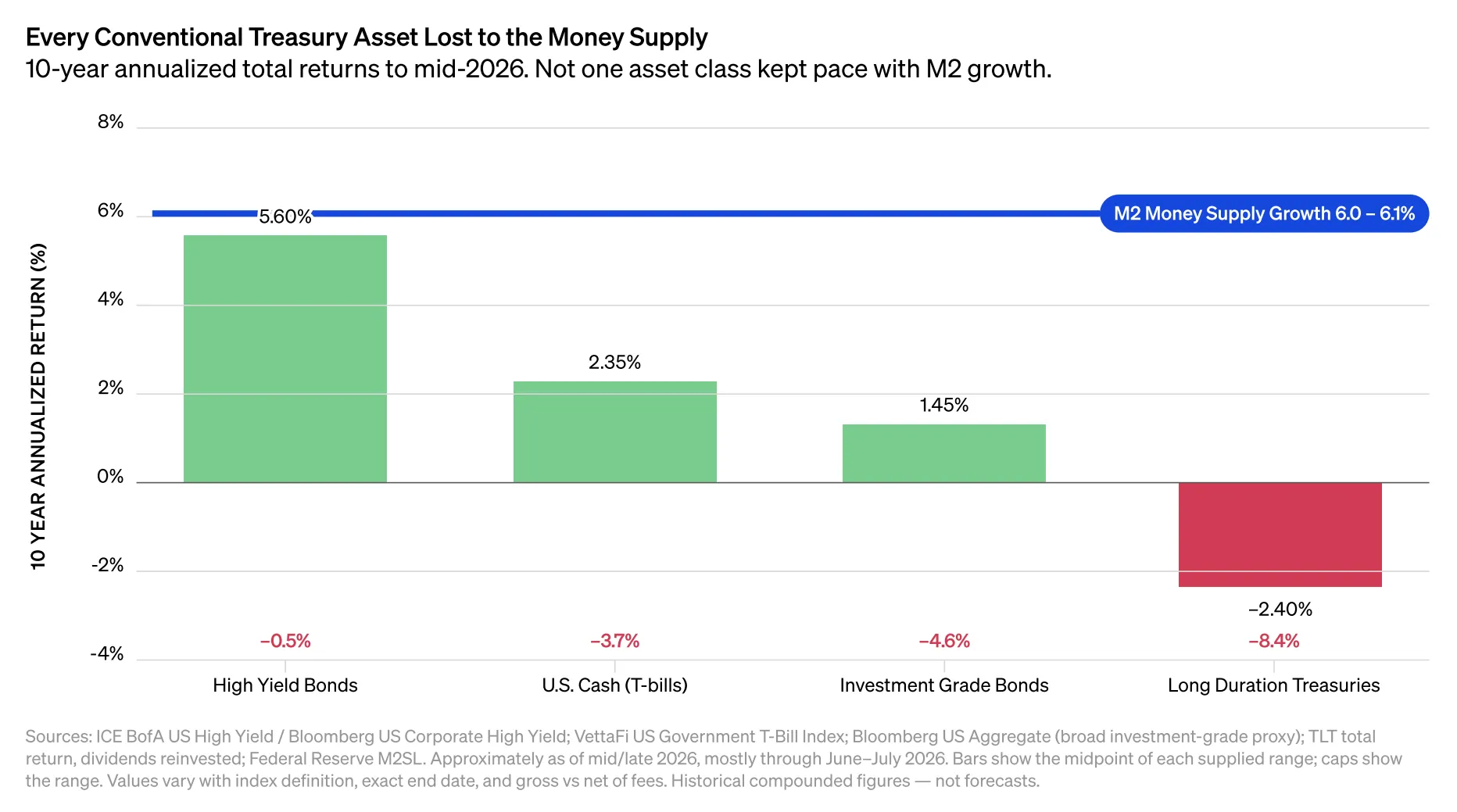
Measured against M2 growth of roughly 6.0–6.1% a year, every conventional treasury asset class delivered negative real returns over the past decade. High-yield bonds came closest at 5.60% nominal — still −0.5% real. Long-duration Treasuries lost the most ground, at −8.4%.
Every conventional treasury asset lost to the money supply. 10-year annualized total returns to mid-2026 against the M2 reference line. Bars show the midpoint of each supplied range. Historical figures — not forecasts.
3. Strategy shows both the upside and the drawdown
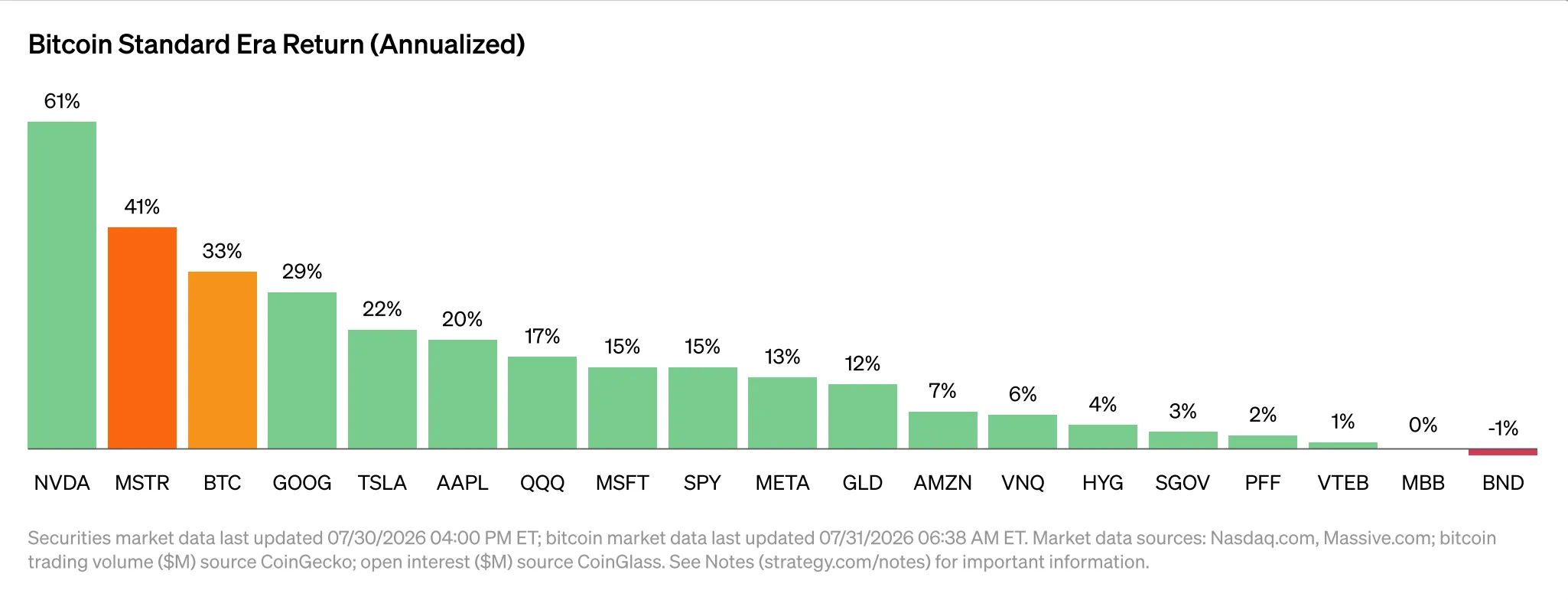
Strategy holds 843,775 BTC and has outperformed every S&P 500 company bar Nvidia since 2020 — yet at $63,408, that same position carried an unrealized loss of roughly $10.18 billion. The clearest case for a bitcoin treasury is also the clearest case for having a policy: a defined allocation band, funding that doesn't depend on trading above NAV, and dividend coverage that never forces a sale into weakness.
843,775 BTC — largest corporate holder globally
~$75,476 — average cost basis per BTC
~$10.18 billion — unrealized loss at $63,408
4. Security is the cornerstone — and it's where BitGo stands out

The biggest risk in holding bitcoin isn't price — it's inadequate custody. Without proper safeguards, holdings can be lost to human error, hacks or theft, which makes custody the most critical operational decision in the strategy. Corporations weigh self-custody, third-party custody and collaborative custody; most treasurers partner with a regulated qualified custodian, mirroring how institutions already hold stocks and bonds. BitGo has provided institutional digital-asset custody since 2013, and three recent developments are directly relevant to a treasurer's diligence.
Federally chartered national trust bank — OCC-approved on 12 December 2025 (BitGo Bank & Trust, National Association), placing custody under direct federal supervision.
Public company — listed on the NYSE as BTGO on 22 January 2026, pricing at $18 per share and raising $212.8 million at a valuation of roughly $2 billion, making audited financials a matter of public record.
Scale and oversight — approximately $104 billion in assets under custody as of 30 September 2025, up 96% year over year, with oversight from more than 50 U.S. federal, state and foreign regulators.
SOC 1 Type II and SOC 2 Type II audits, with up to $250 million of insurance for digital assets held in qualified custody.
MPC-based key management, granular policy controls and segregated custody that eliminates single points of failure.
"BitGo has invested the time and energy to bring the best financial tools from mainstream treasury management to digital currency, and it shows in the quality of their products and services."
— Nejc Kodrič, Co-Founder, Bitstamp
5. Adoption grew from a single pioneer into a sector
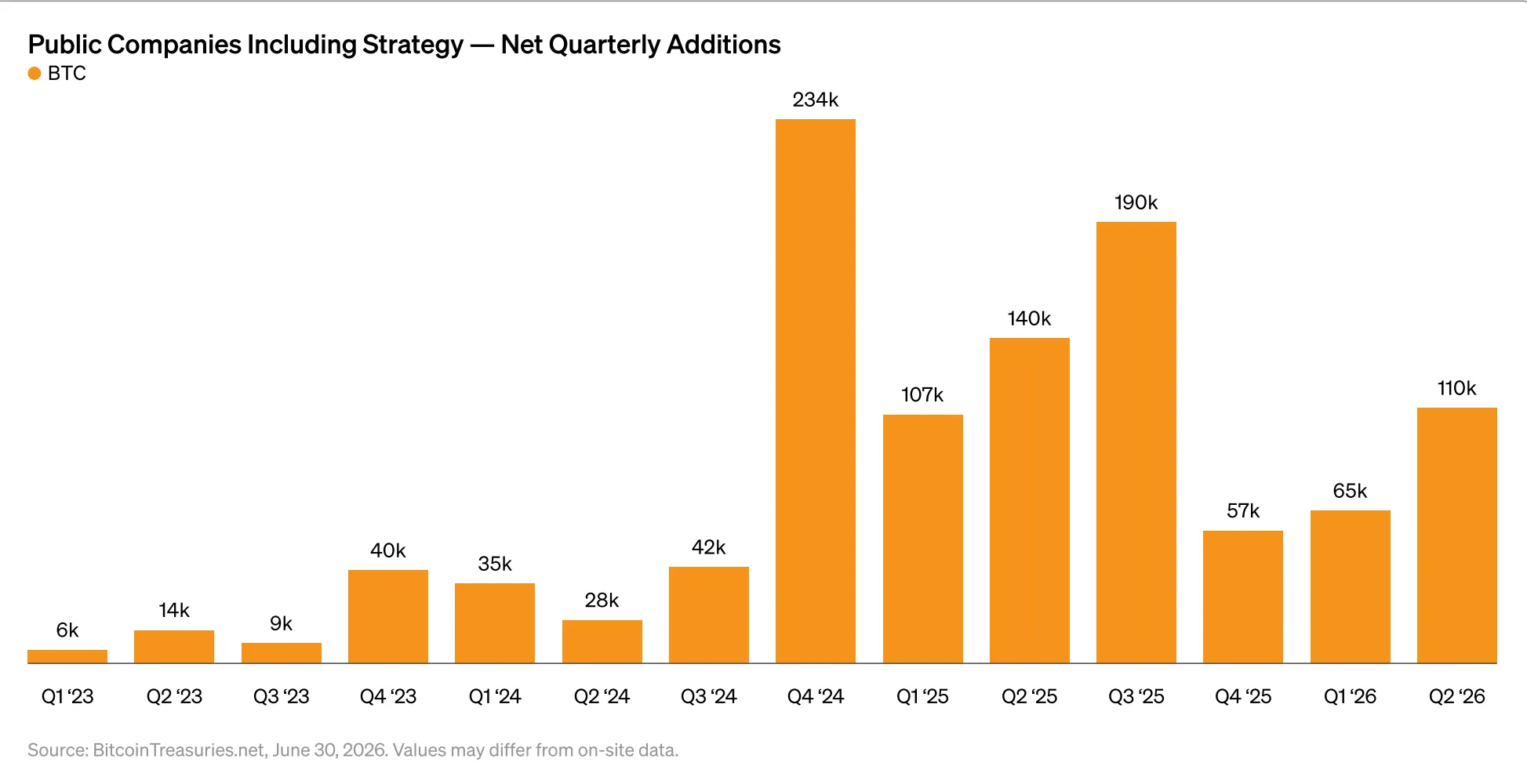
As of 30 June 2026, publicly traded companies held approximately 1.265 million BTC — the top 100 alone accounted for 1.262 million. Net additions have run positive every quarter since 2023, funded increasingly by preferred-share instruments rather than operating cash flow alone.
For further analysis, or to discuss trends driving your investment or treasury strategy, reach out to our research team at office@bitcointreasuries.net.
Want more bitcoin treasury coverage in your search results? Add Bitcoin Treasuries as a preferred source on Google.