
Capital B's Alexandre Laizet on Why Digital Credit Is 3x Bigger Than the Equity Play



Europe's race for a Bitcoin-backed credit instrument is intensifying, and Capital B is positioning itself to lead it. In a interview with BitcoinTreasuries.NET, deputy CEO and director of Bitcoin strategy Alexandre Laizet sets out why he sees digital credit as the largest opportunity, and lays out where he expects the European race to head over the next three to five years.
Alexandre Laizet has spent the past year and a half doing two things at once: buying Bitcoin, and building the balance sheet that will let Capital B monetise it twice. On 3 August, the company confirmed that Blockstream Capital Partners had converted the last of its OCA B-01 notes into ordinary shares, closing out the tranche that took Capital B from 40 BTC to over 2,000 BTC in its first year. The company's holdings now stand at 3,140 BTC. For Laizet, that conversion is not a debt clean-up story. It is a capacity story.
A capital markets background, not just Bitcoin conviction
Laizet joined Capital B, Europe's first listed Bitcoin treasury company, from Accenture, where he spent his prior role as digital assets lead advising more than thirty financial institutions on institutional Bitcoin adoption. He now sits on the board as deputy CEO and director of Bitcoin strategy, a title that reflects the case he makes throughout the conversation: that Bitcoin conviction alone does not build a treasury company. He described the wider board as bringing more than seventy combined years of banking and technology experience, paired with what he calls a genuinely maximalist read on Bitcoin's long-term trajectory.
The company's backer list, he said, mixes Adam Back as its largest individual shareholder with Blockstream Capital Partners, TOBAM, UTXO Management, more than fifty institutions and some 30,000 individual investors. That combination, in his framing, is what has let Capital B run an institutional-grade playbook rather than an opportunistic one through a bear market that has already forced weaker treasury strategies to unwind.

The conversion frees Bitcoin from any liability
The mechanics matter here. Laizet walked through how a company's capacity to issue a Bitcoin-backed credit instrument is calculated: take the total BTC held, strip out whatever portion is still linked to a liability such as a convertible note, and the remainder is the "equitised" Bitcoin base against which credit can be issued. Before the Blockstream conversion, roughly 821 of Capital B's 3,140 BTC sat behind convertible notes. Laizet estimated the Blockstream conversion alone adds ten to twenty million euros of freed capacity, on top of BTC already unencumbered. Crucially, he stressed that the notes were not repaid, they were converted, and at a price above where the shares were trading when the deal was struck. He reads that as a signal of long-term shareholder alignment rather than a forced restructuring. He also pointed to a "free diluted share reserve" that Capital B built alongside its cash and Bitcoin operational reserves, which absorbed the dilution from the conversion and left the company's fully diluted share count roughly a million shares lower than its own conservative estimate.
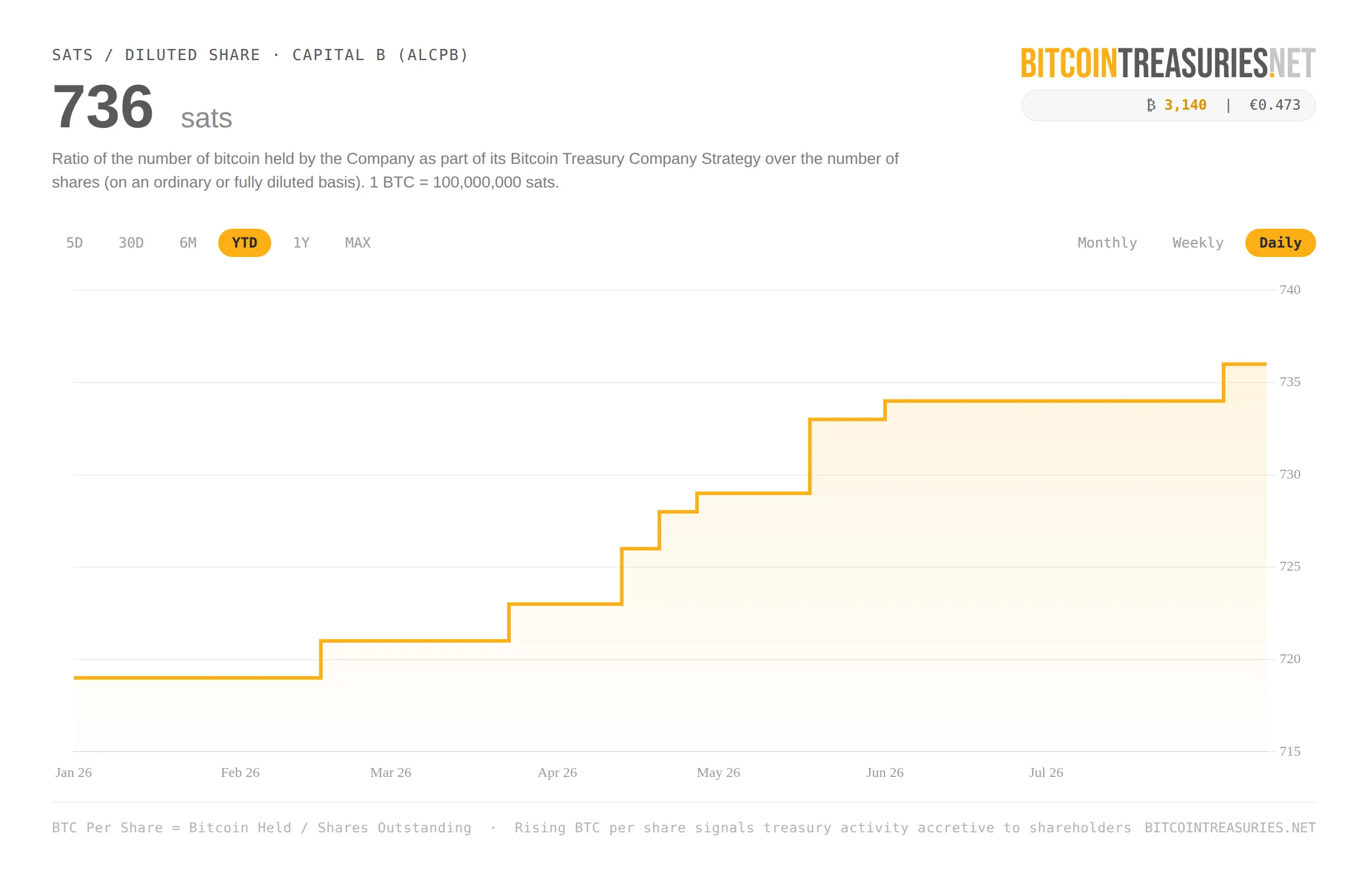
Laizet set those numbers against a bear market he says the company had explicitly planned for: five-year minimum maturities on its converts, Bitcoin-denominated debt rather than fiat leverage, and no equity lines. Over the twelve months to August, Capital B grew Bitcoin per share by 18 per cent. Year to date, in what he called the depth of the bear market, that figure is 2.1 per cent, a number he set directly against the three to five per cent that levered or option-based strategies typically advertise, without the underlying risk those strategies carry.
Credit is three times bigger than equity, and that is the opportunity
The framing Laizet returns to most often is a comparison of market size. Global equity markets, he said, are worth around $100 trillion. Global credit markets, including bonds and hybrid instruments, are closer to $300 trillion. Bitcoin's total market value today is roughly $1 trillion, against gold's $20 to $30 trillion. His argument is that Bitcoin-backed digital equity, instruments like Strategy's preferred stack or Strive's SATA, has already shown what happens when Bitcoin is packaged for capital that wants equity-like returns. Digital credit, in his view, is the far larger and mostly untapped opportunity, because it is aimed at a pool of fiat-denominated capital that wants low volatility and modest yield rather than upside exposure, and that pool is several times the size of the equity market.
He leaned on Friedrich Hayek's writing on the denationalisation of money, a reference he credited to TOBAM's Yves Choueifaty, to argue that Bitcoin treasury companies are effectively acting as the private issuers Hayek anticipated: entities that sit on top of Bitcoin as the base asset and issue their own fiat-denominated instruments against it. "People think traditional finance is entering Bitcoin," he said, "but Bitcoin is entering traditional finance." He was careful to frame the scale of that opportunity as illustrative rather than predictive: capturing even 10 per cent of the $300 trillion credit market would put $30 trillion of demand behind Bitcoin, a figure he compared to gold's own market capitalisation, while explicitly caveating that he has "no crystal ball." He pointed to STRC's recovery to the high nineties, within reach of its $100 par, as evidence that this cohort of investor, distinct from equity-driven, momentum-based capital, is already re-engaging after the stress the sector saw earlier this year.
Capital B won't commit to a launch date, but keeps every option open
Despite the framing, Laizet was explicit that Capital B has not announced any digital credit product and would not commit to a timeline. Digital credit is the company's core strategic focus, he said, but "it's not done until it's not done." He also pushed back gently on the idea that Capital B should converge on a single flagship instrument. Maintaining optionality across financing tools, he argued, is not incompatible with pursuing a leading credit product, and in his view actually strengthens the eventual product by maximising convexity and Bitcoin-per-share growth in the meantime. Not all convertible structures are equal, he noted: Capital B's carry no shorting mechanics and no put dates ahead of a five-year maturity, a structural distinction he thinks the market underprices relative to the shorting-linked converts that funded some of Strategy's own early growth.
Issuers first, then funds, over three to five years
Asked whether digital credit in Europe would consolidate around a handful of large issuers or fragment across many smaller ones, Laizet described it as a matter of sequencing rather than an either/or. The United States, he said, is already advanced, pointing to STRC's ranking among top-line instruments in Bitcoin-linked credit ETFs, while most of Europe still has the groundwork to do; he cited Metaplanet's instrument as early but not yet fully listed, and pointed to The Smarter Web Company's court-approved reduction and Bitcoin Treasury Capital's Swedish preferred, paying around 10 per cent, as early signs of a European market forming. He expects more issuers to arrive first, since a fund typically needs six to ten distinct instruments before it can launch, and expects that fund layer to follow once the issuer base is broad enough. He put a three-to-five-year window on that innovation cycle, with Strategy's own preferred stack, and its evolution over time, as the template other issuers are already studying.
By his own account, the industry Laizet describes is still small enough that its growth compounds rather than dilutes: at roughly 0.1 per cent of the traditional asset universe, he argued, every dollar of new capital that enters makes the next dollar easier to attract, rather than harder. Capital B's own next move, on that logic, is less about announcing a product than about making sure its balance sheet has nothing standing in the way when it does.
Want more bitcoin treasury coverage in your search results? Add Bitcoin Treasuries as a preferred source on Google.