
Michael Saylor’s Strategy Officially Back in Profit as Bitcoin Surges Above $77,000



Strategy (MSTR), the world’s largest corporate Bitcoin holder under Executive Chairman Michael Saylor, has moved back into unrealized profit on its massive Bitcoin treasury following a sharp price rally. At the time of writing on August 21, 2026, Bitcoin is trading around $77,000, pushing the value of the company’s holdings well above its cumulative acquisition cost for the first time in roughly three months.
As of the latest disclosures, Strategy holds 840,447 BTC. The company acquired this stack at an average price of $75,385 per Bitcoin (including fees and expenses), for a total cost basis of about $63.36 billion. At $77,000, the holdings are worth roughly $64.71 billion, generating an unrealized gain of approximately $1.36 billion.
This marks the first sustained return to profitability since late May 2026. On May 25, with holdings near 843,700 BTC and an average cost around $75,700. The subsequent multi-month decline left Strategy with billions in paper losses at times exceeding $10 billion before the latest rebound.
The STRC Episode and Liquidity Concerns
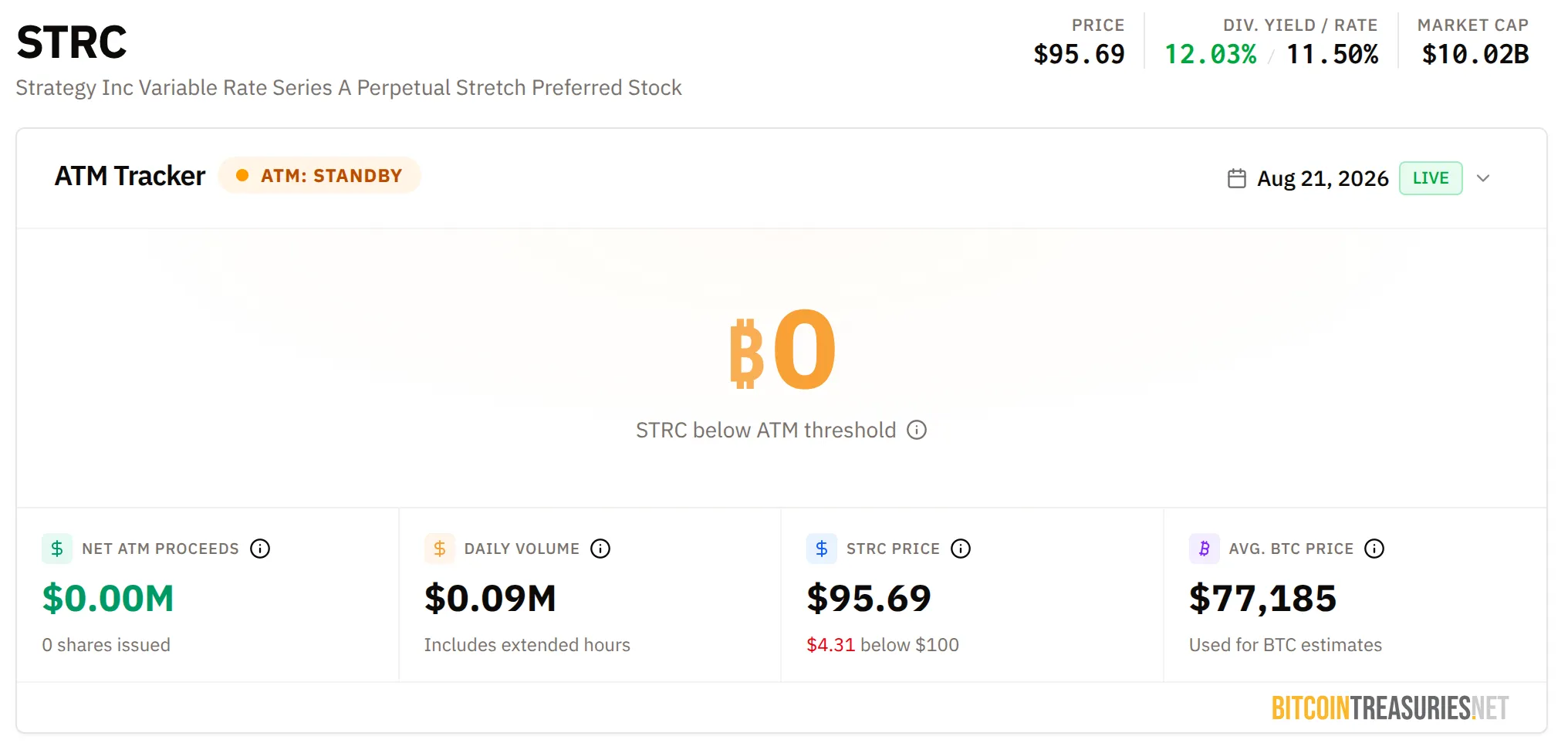
The period of underwater holdings coincided with significant pressure on Strategy’s preferred stock product, STRC (Variable Rate Series A Perpetual Stretch Preferred Stock). Designed to trade near its $100 par value and pay a variable monthly dividend (recently around 12%), STRC serves as a key capital-raising tool: when it trades at or above par, Strategy can issue more shares via at-the-market offerings and deploy the proceeds into Bitcoin.
During the Bitcoin sell-off, STRC slid sharply below par. It reached an all-time low of $71.25 in late June 2026, drawing intense criticism. Some observers warned of a potential “collapse,” arguing the company might be forced to sell large amounts of Bitcoin to cover preferred dividends and interest obligations, risking a cascading liquidation.
Those fears proved overstated in the near term. Strategy has sold limited quantities of Bitcoin and, more substantially, issued common stock (MSTR) to raise capital. It built a dedicated U.S. dollar reserve that recently reached $4.8 billion. This buffer now provides approximately 2.8 years of coverage for preferred dividends and debt interest payments.
The company has emphasized that the reserve is restricted primarily to supporting these obligations. Even in a severe scenario where Bitcoin fell to $20,000, Strategy’s cash position and capital structure would have allowed it to meet near-term payments without a catastrophic forced liquidation of the core Bitcoin holdings. The company has also conducted selective STRC buybacks to support the preferred stock price.
As of August 20–21, 2026, STRC was trading around $95.25–$95.5, well recovered from its lows though still short of a full return to par.
Short Squeeze Fuels the Rally
The latest Bitcoin surge has been driven in large part by a classic short squeeze. After weeks of range-bound trading and elevated bearish positioning, a wave of short liquidations—estimated at $3 billion or more across crypto markets over a short period, the largest concentrated short squeeze in years—forced traders to buy back Bitcoin to cover positions. This mechanical buying amplified upward momentum, helping push prices from the mid-$60,000s toward the mid-$70,000s and beyond in a matter of days.
Additional tailwinds included improving macro signals, such as U.S. Treasury actions supporting bond markets, and renewed optimism around crypto regulation. Some market participants are now eyeing $80,000 as a potential target before month-end, though sustained demand beyond forced covering will determine whether the move holds.
Strategy’s Bitcoin treasury remains the dominant corporate holding by a wide margin, representing roughly 4% of Bitcoin’s eventual 21 million supply cap. The return to unrealized profit provides a temporary reprieve from mark-to-market losses that have weighed on reported earnings under fair-value accounting. However, the company’s long-term thesis continues to rest on Bitcoin’s scarcity and adoption rather than short-term price fluctuations.
Investors should note that unrealized gains or losses can reverse quickly with market moves, and preferred stock dynamics remain sensitive to both Bitcoin’s path and Strategy’s capital management decisions.
Want more bitcoin treasury coverage in your search results? Add Bitcoin Treasuries as a preferred source on Google.