
Strategy Gives Itself 27 Trading Days To Return STRC To Par After Q2 Earnings


Strategy grew its Bitcoin holdings by 11% and cut its Strategy Holds Fire on New Deals Until STRC Returns to Parconvertible debt by 18% in the second quarter of 2026, against an $8.33 billion operating loss caused almost entirely by the falling Bitcoin price. But the call kept returning to a single instrument. Almost every question about doing something new was declined on the grounds that it would complicate STRC, and the July numbers show capital being diverted to defend it.
The headline loss looks worse than the quarter was. Strategy's $8.33 billion operating loss for the three months to 30 June consisted almost entirely of an $8.32 billion unrealised writedown on its Bitcoin, a consequence of fair value accounting rather than of anything the company did. GAAP net loss came in at $8.22 billion, rising to $8.62 billion once $400.7 million of preferred dividends are deducted, or $24.45 per diluted share. Andrew Kang, the chief financial officer, referred to the larger figure in his prepared remarks, so it is worth being clear that the $8.6 billion number is the loss attributable to common shareholders rather than the company's net loss.
Underneath that, the operating picture was one of accumulation. Bitcoin holdings rose from 762,099 to 846,000 over the quarter, bought at an average of roughly $75,300, funded by $8.41 billion raised through the at-the-market programmes. Of that, $5.47 billion came from STRC and $2.95 billion from common stock. Convertible notes came down from $8.21 billion to $6.71 billion after the company repurchased $1.50 billion of its 2029 notes at an 8% discount to par, booking a $113.9 million gain in the process. Bitcoin Per Share, the metric management treats as the scoreboard, rose 5% to 210,824 sats, which was better than the 3.2% recorded in the first quarter despite a considerably worse Bitcoin price.
The software business, easy to forget, turned over $122.4 million, up 6.9% year on year, at a 66.6% gross margin.
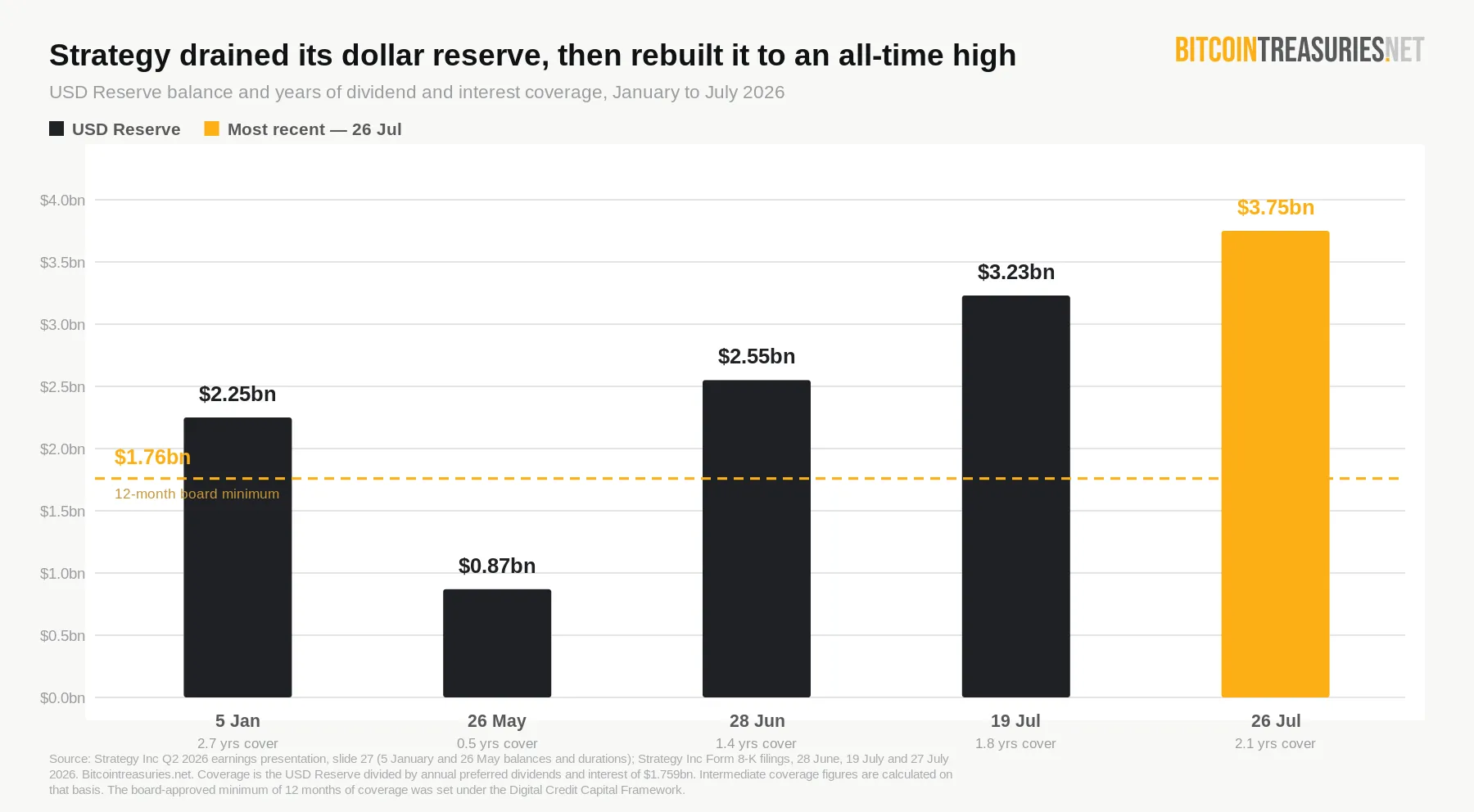
As things stand, Strategy holds 843,775 Bitcoin, a little over 4% of the eventual supply, worth roughly $53.9 billion. The USD Reserve sits at $3.75 billion, the highest it has ever been. MSTR closed at $97.74 for a market capitalisation of $37.6 billion, which is 1.05 times net asset value. The stock is down 75% over twelve months.
The dollars rethink
The most substantive change in posture came in response to a question from Lyn Alden about target leverage and whether the company intends to be countercyclical.
Michael Saylor's answer amounted to a correction of the company's founding reflex. Strategy had, he said, "underestimated the value of US dollars." Running at 98% or 99% Bitcoin "actually was counterproductive," because the Bitcoin investors, the equity investors and the credit investors all disliked it. Going forward, proceeds from credit sales will not automatically be converted in full. "I don't think it'll be 100% in the future. I think it'll be a mix," with the split informed by Bitcoin's premium to its 200-week moving average, a metric the company has now put on its website precisely so investors can see what management is watching.
Phong Le was blunter about how the lesson was learned. At around nine months into STRC's life, he said, "we learned the hard way that we shouldn't let our left-brained Bitcoin bulls say that everything we can issue, we just pour into Bitcoin." He added that cutting the STRC dividend rate when Bitcoin is strong would make sense, which is close to the opposite of the reflex the market has come to expect.
Saylor's summary of the shift is the line most likely to be quoted: "Maybe the best way to buy the most Bitcoin is not to buy the most Bitcoin."
The July numbers show it in practice. The company raised $1.28 billion of common stock in the month, sold 2,225 Bitcoin, and bought none, directing the money instead into the USD Reserve and into buying back STRC. Bitcoin Per Share has fallen from 210,824 sats at quarter end to 203,683, which is why year-to-date BTC Yield stands at 4.5% when the first two quarters together came to 8.2%.
Stretch, and only Stretch
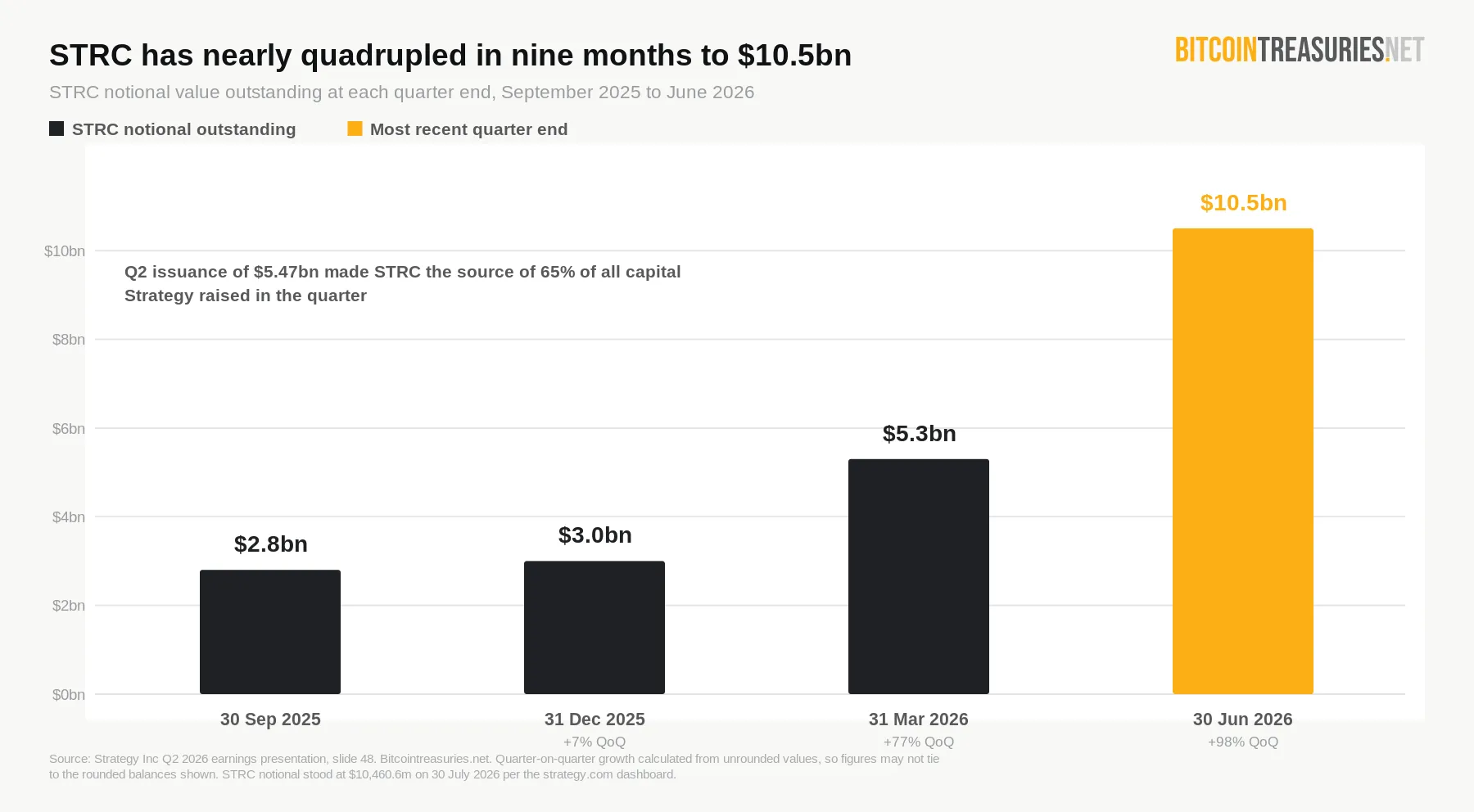
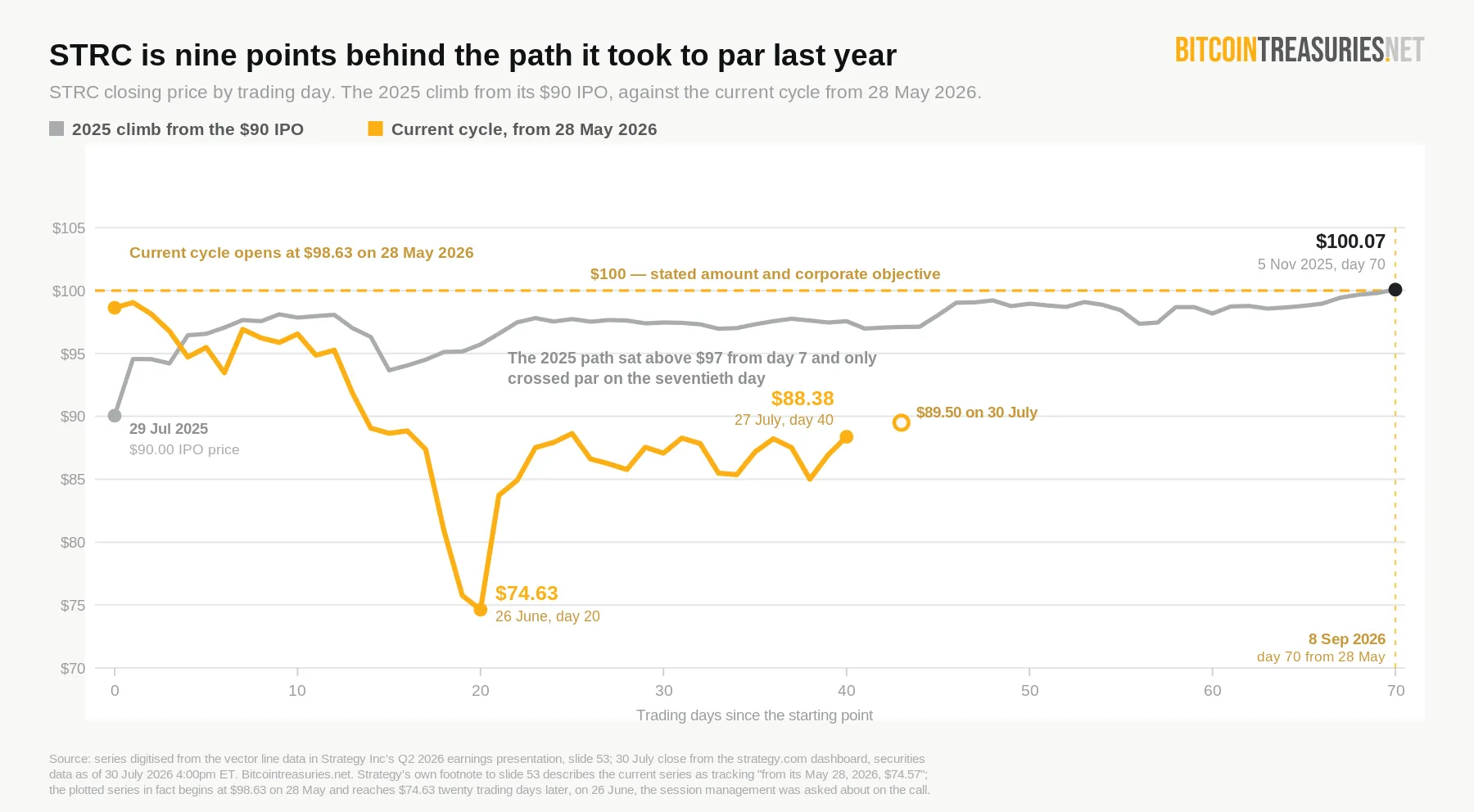
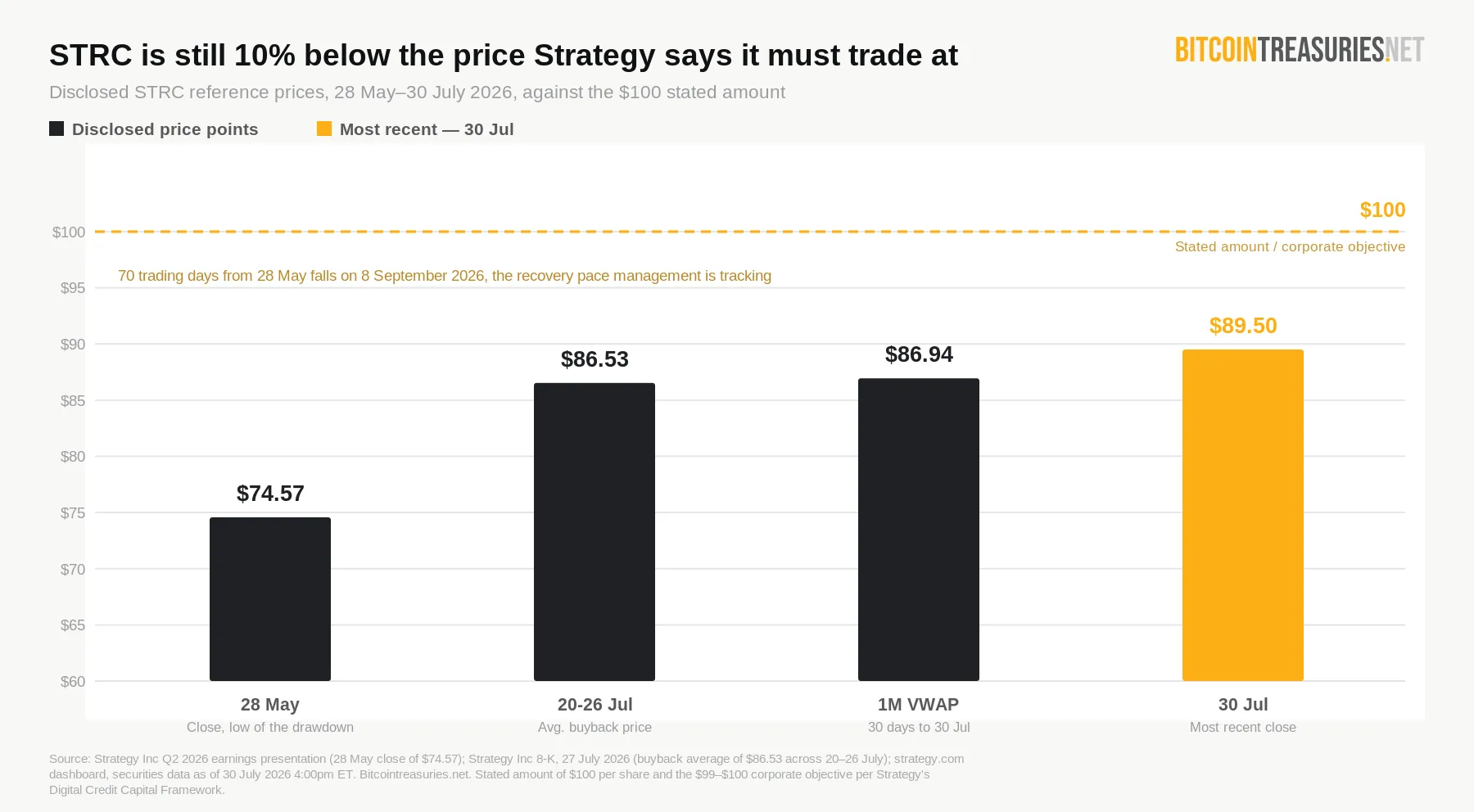
STRC has grown from $2.8 billion of notional a year ago to $10.5 billion today, and it now trades at $89.50 against a stated amount of $100, leaving a gap of roughly $1.1 billion between notional value and market capitalisation. Closing that gap was, by some distance, the dominant subject of the call.
The tools are laid out plainly. The dividend rate has been raised to 12% and will stay there until STRC trades healthily near par, and management said that raising the rate further has not proved an effective route back. Payments have quietly moved from monthly to semi-monthly. A $1 billion repurchase programme has so far bought $28.89 million of notional for $25 million, at an average of $86.53, and the company says it intends to be a regular and disciplined buyer, taking more at deeper discounts and tapering as the price approaches par. Some $975 million of that authorisation remains.
Saylor also offered a timeline of sorts. STRC took 70 trading days to reach par after listing at $90; it dropped out of its $99 to $100 range on 28 May; 70 trading days from there falls around 8 September, and he said the company is tracking that date.
Where he was least equivocal was on the question of ever selling STRC below par. Asked by Lance Vitanza how investors should tell foundational principles from flexible ones, Saylor said that if offered $10 billion for the instrument at $99.99, "I wouldn't give you the penny." The alternative, he said, is to sell nothing at all, which is what happened in July: no preferred stock was issued at all during the month. His analogy was kerosene, and the point was that a fuel which sometimes damages the engine is worse than no fuel. "If we can't create pure short-duration credit at par, we'd rather just sell nothing at all."
What happened on 26 June
The most genuinely new disclosure came late, in response to James Van Straten asking what caused STRC to trade down to around $70 in late June.
It was not, Saylor said, retail investors over-borrowing, and it was not a decentralised finance liquidation, which had been the popular assumption. A number of broker-dealers had been extending credit against STRC at advance ratios of 70% or 80%, priced off the instrument's previously very low volatility. When volatility spiked, those lines were cut back to around 20% or pulled altogether. The resulting forced selling pushed the price down, which raised volatility further, which triggered more withdrawal of credit. He described it as "a second-order, third-order reflexive contraction in credit," and said the episode was unexpected.
It also explains a good deal of the rigidity elsewhere in the call. Stability at par is not being defended for its own sake; it is what keeps other people's leverage available to buyers of the instrument.
Everything management declined to do
Four separate questions invited Strategy to widen its toolkit, and all four were turned down.
Mark Palmer asked whether the company would borrow against its Bitcoin from a bank in order to build the reserve faster. Le said the market for such lending is smaller and worse priced than people assume, and Saylor added that a mark-to-market loan on the balance sheet would create "an attack surface and an attack narrative for short sellers."
Matt Hougan asked whether more instruments are coming, and whether the company might sell volatility in the derivatives market. Saylor said the direction of travel is the opposite: the eleven existing credit instruments will be whittled down over time, and given the chance again, "I would do no bonds. I would just sell STRC." On selling volatility, his objection was that stripping upside out of the common stock would penalise the very equity holders who bought it for that upside, would create tax complications, and would compete with the trading desks whose activity Strategy depends on. "I don't want to steal their opportunity."
Samson Mow asked about covered calls and cash-secured puts, and received the same answer. Anyone with Bitcoin can sell options against it; almost nobody can sell digital credit against it at scale.
Mow also asked whether preferred instruments crowd out ordinary people discovering Bitcoin itself. Saylor's response was that the marketing is aimed at the 99% who will not, cannot or may not buy Bitcoin directly, and that nobody sells Bitcoin in order to buy STRC.
Where it leaves things
Strategy's own framing is that the market currently ascribes almost no value to the credit business it has built, given that the equity trades barely above the value of its Bitcoin net of debt and preferred claims. Management's case is that selling $5 billion or more of credit a year against a cost of credit it now publishes as 10.8% is a genuine operating business, and that a multiple will follow once STRC is demonstrably stable.
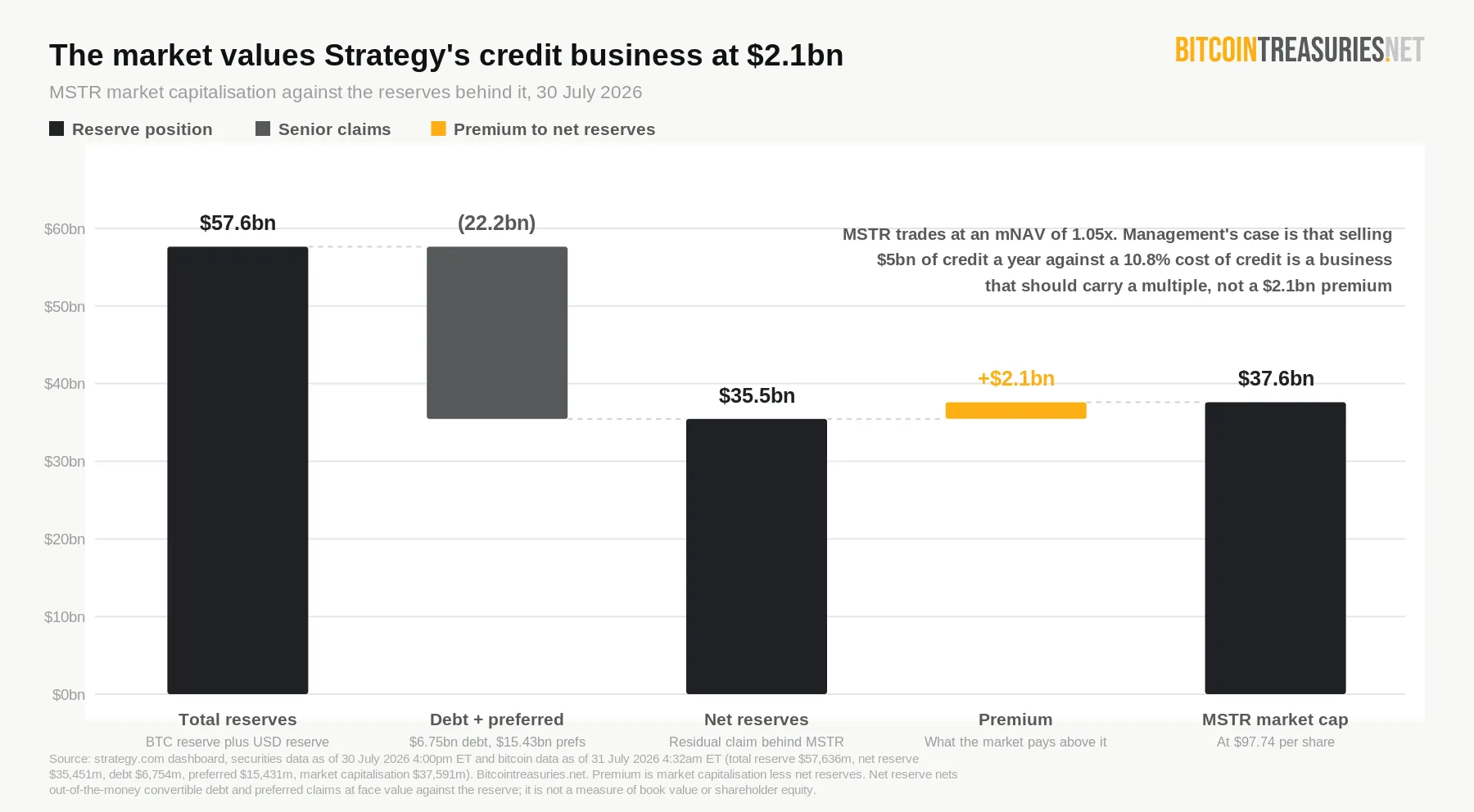
Whether that happens rests on one instrument getting back to $100. On the evidence of this call, nothing else is being contemplated until it does.
Want more bitcoin treasury coverage in your search results? Add Bitcoin Treasuries as a preferred source on Google.