
Why Strategy Should Keep Selling Bitcoin Until Stretch Trades at Par



$106 million of cash has retired $120 million of Stretch face and closed 580 basis points of the discount to par. The same filings show Strategy building the dollar liquidity S&P Global Ratings named as its condition for an upgrade.
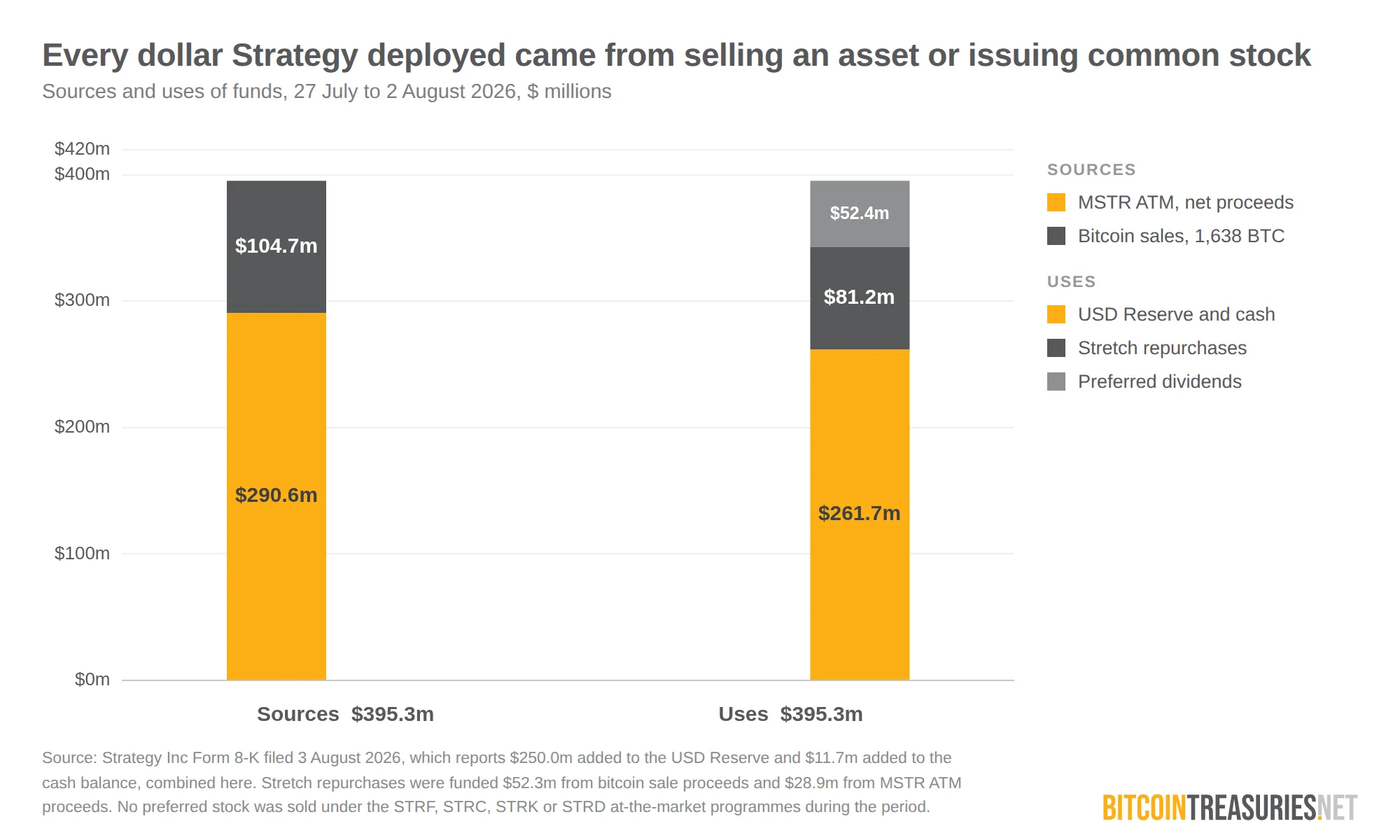
Last week, Strategy sold 3,011,361 MSTR shares for $290.6 million net, or $96.50 a share against an average close of $95.83 over the period's five sessions. The company also sold 1,638 bitcoin at an average of $63,957, raising $104.73 million and taking holdings to 842,138 BTC. That is 0.194% of the stack.
The filing accounts for every dollar. Of the ATM proceeds, $250.0 million went to the USD Reserve, $28.9 million to Stretch repurchases and $11.7 million to cash. Of the bitcoin proceeds, $52.4 million funded preferred dividends and $52.3 million funded more Stretch repurchases. No bitcoin was bought. Every dollar deployed this week came from selling an asset or issuing common stock. None of it came from new credit.
Convexity, not scale, is closing the discount
The second tranche of STRC buybacks took 912,143 shares for $81.2 million, an average of $89.02. Added to the 288,930 shares bought for $25.0 million in the week to 27 July, the programme has now retired 1,201,073 shares - $120.1 million of face - for $106.2 million of cash at a blended $88.42.
The leverage sits in the gap between those two numbers. Face retired equals 1.15 per cent of the $10,489.5 million notional outstanding before the programme began, but the cash cost is only 1.01 per cent of that notional. Every dollar spent retires roughly $1.13 of face. Stretch notional now sits at $10,369.4 million after the second tranche.
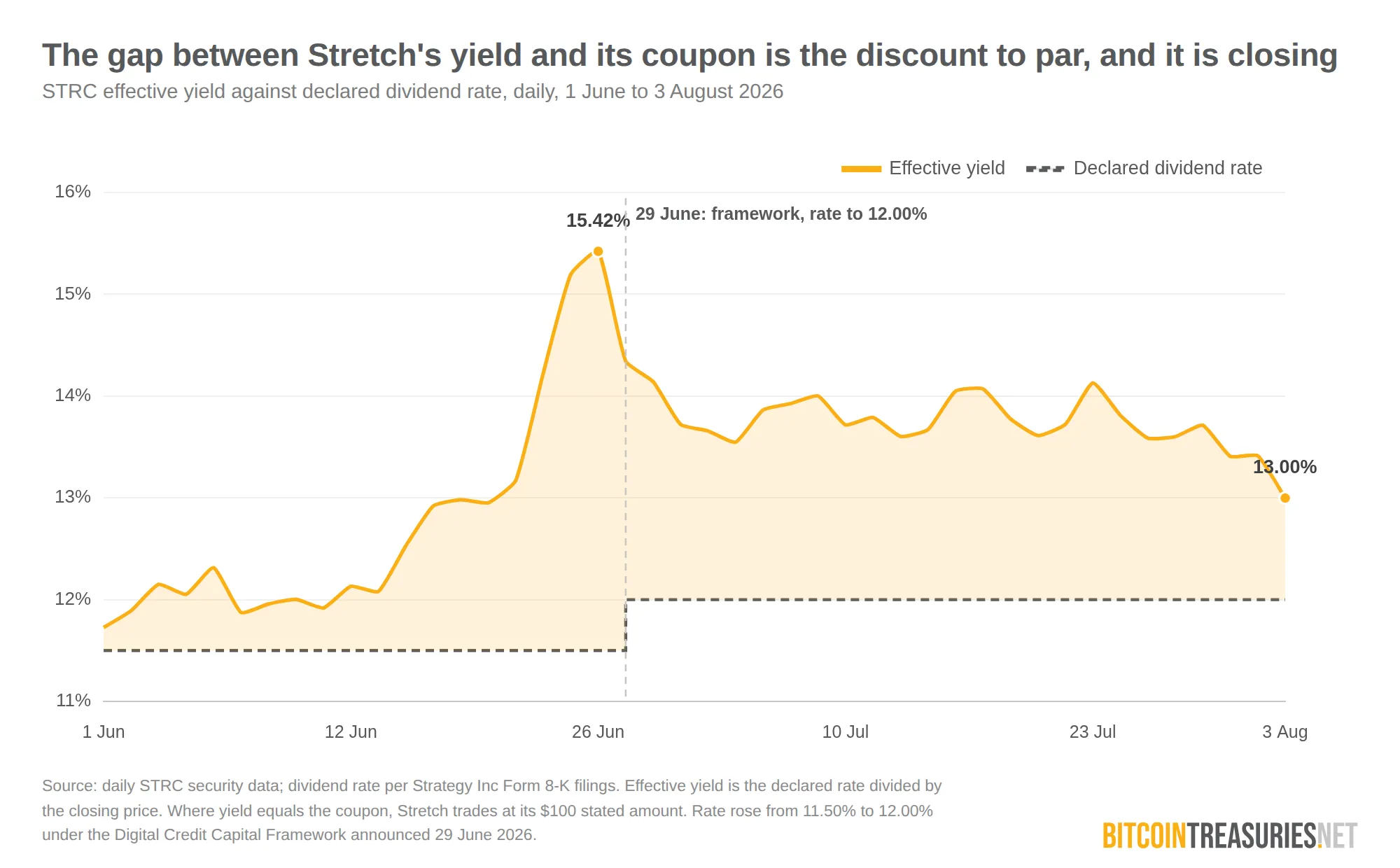
Stretch closed at $92.32 on 3 August. That is 6.70 per cent above the first tranche's execution average and 4.41 per cent above the blended average. The discount to the $100 stated amount has narrowed from 13.48 per cent to 7.68 per cent, and the effective yield has compressed to 13.00 per cent from 15.42 per cent at the 26 June low of $74.57. Measured from the first execution price, 580 basis points of a 1,348 basis point gap have closed for $106 million.
Bitcoin rose 7.22 per cent between the framework announcement on 29 June and 3 August, and Stretch rose 10.34 per cent. The buyback is one input among several. It is not the only one.
Holding the rate at 12 per cent costs less than cutting it
Strategy confirmed on 31 July that the Stretch dividend rate stays at 12.00 per cent per annum for semi-monthly periods beginning on or after 16 August, with $0.50 a share declared for the periods ending 31 August and 15 September. The filing repeats that management will not recommend a change until Stretch demonstrates sustained trading at or near its $100 stated amount.
The arithmetic supports the decision. Retiring $120.1 million of face removes $14.41 million of annual dividend obligation for $106.2 million of cash - a 13.57 per cent cash-on-cash return, better than the 13.00 per cent effective yield the market is currently offering on the same instrument. The annual Stretch dividend bill falls from $1,258.7 million to $1,244.3 million. A rate cut would reach the same expense reduction faster and destroy the near-par expectation on the way. Buying face at a discount reduces the bill without touching the promise.
This is the mechanism the company's own Q3 marketing deck, filed on 3 August, describes as a move from one-way capital issuance to active capital management. The deck states the corporate objective for Stretch as trading at $99 to $100 over time, and lists reducing the annual dividend and strengthening credit quality as the first two purposes of the repurchase programme.
The reserve build is addressed to S&P Global Ratings
The USD Reserve reached $4.0 billion as of 2 August, including unsettled ATM proceeds. Against the $1.76 billion of annual interest and preferred dividends disclosed in the same deck, that is 27.3 months of coverage. In late May the reserve stood at $871 million, or roughly six months.
The audience for that number is not only Stretch holders. When S&P Global Ratings assigned Strategy a B- issuer credit rating with a stable outlook in October 2025, it cited low US dollar liquidity and very weak risk-adjusted capitalisation among its reasons, and indicated an upgrade was unlikely without a material increase in dollar liquidity and reduced reliance on convertible debt. Convertible principal fell from $8.2 billion to $6.7 billion during the second quarter after the $1.5 billion repurchase in May. The reserve has since quadrupled. The December affirmation was reported to treat the reserve as a credit positive, with an expected prefunding band of 12 to 24 months; $4.0 billion sits above the top of that band.
Preferred face is coming down and dollar liquidity is going up. Those are the two things the agency asked for.
What the next filings settle
$893.8 million of the $1.0 billion digital credit authorisation remains, and the $1.0 billion MSTR repurchase authorisation is untouched. Strategy has spent 10.6 per cent of its preferred capacity to close 43 per cent of the discount gap it started with, which means the remaining ground to par is both thinner and dearer.
Two variables decide the rest. If Stretch clears $95 at this pace, the rate reset becomes a live question rather than a deferred one. If bitcoin weakens and the common equity window narrows, the reserve stops being the instrument doing the defending and becomes the thing being defended. On current disclosure the ordering is not ambiguous. Stretch comes first.
Want more bitcoin treasury coverage in your search results? Add Bitcoin Treasuries as a preferred source on Google.