


Connecting Excellence Group has built something unusual in the treasury company field: a cash-generative operating business designed from the ground up to feed a Bitcoin balance sheet, rather than a Bitcoin balance sheet bolted onto an existing company. Its latest investor materials show the mechanics of that design, and the milestone that matters most sits at 200 BTC.
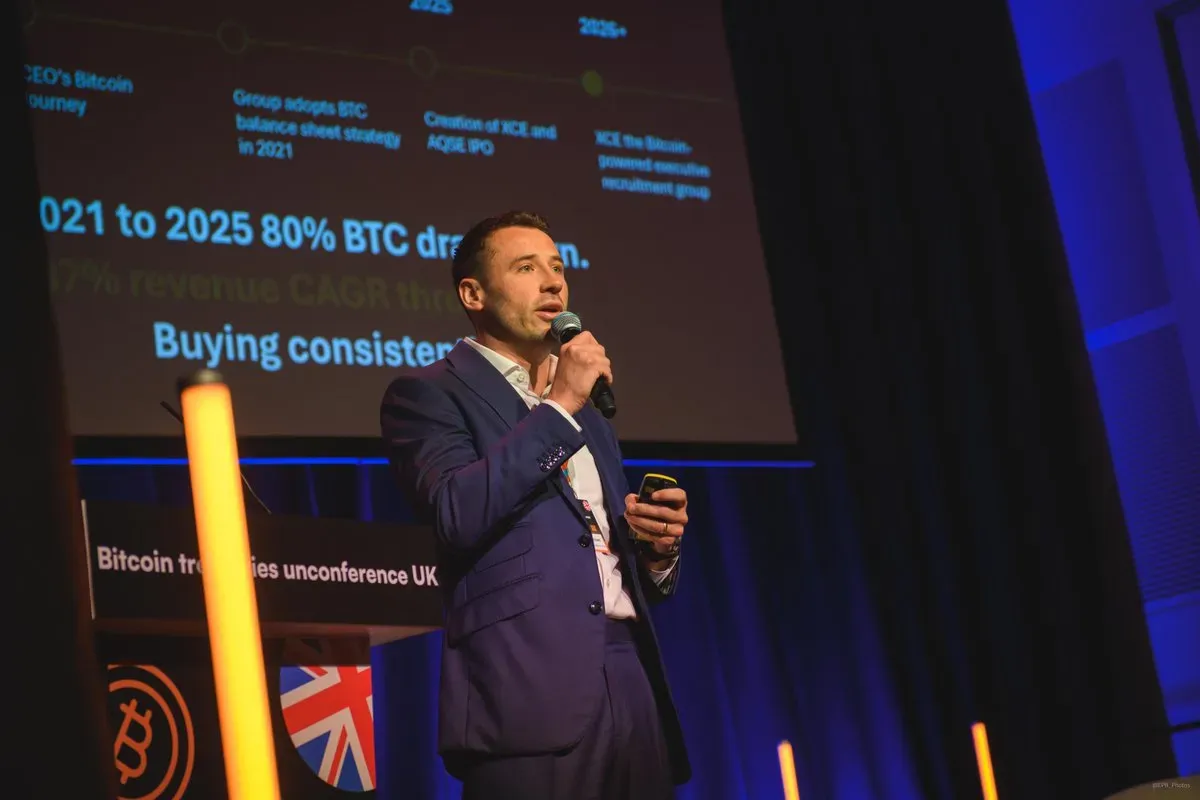
Scott Ellam took XCE's case directly to investors on Thursday, 6 August 2026, presenting at the OTCQB Virtual Investor Conference. His session covered the acquisition model, organic hiring and acquisitions, performance-linked equity incentives, and disciplined capital allocation, closing with a live audience Q&A. The framing he brought to the room matches the line XCE has been building in its investor materials all year: this is not a company whose investment case rests on the Bitcoin price alone. "We're building a different kind of public company," Ellam said, positioning XCE's strategy as recruitment growth and long-term Bitcoin accumulation compounding together, rather than a treasury sitting apart from the business that funds it.
Ellam is candid about where the harder sell lies. Recruitment business owners and the recruiters themselves grasp the model immediately, he told BTN: that part is easy. Investors are different. "Most come at this from one of two directions - they either understand an industry roll-up, or they understand a Bitcoin treasury," he said. "Very few have seen the two built together, because nobody has done it this way before."
A recruiter who bought the drawdown
Scott Ellam founded Spencer Riley, an executive search firm, in 2014. He put Bitcoin on the company's balance sheet in 2021, then kept buying through an 80 per cent peak-to-trough drawdown between 2021 and 2025, while the underlying recruitment business compounded revenue at a 37 per cent CAGR across the same stretch. That combination, sustained buying through a bear market alongside operating growth, is the origin story XCE now tells investors, and it is the thesis the rest of the group is built around.
Spencer Riley became the foundation of Connecting Excellence Group plc, which listed on the Aquis Stock Exchange on 11 December 2025 (AQSE: XCE, OTCQB: XCELF) with Ellam as founder and chief executive. The group now describes itself as a Bitcoin-powered executive recruitment platform, and its investor deck sets out, in granular detail, how the operating business and the treasury are meant to reinforce each other.
The economics of recruitment, repurposed
XCE's pitch for why recruitment works as a Bitcoin-accumulation vehicle rests on the sector's structural features: it is asset-light, cash-generative, built on recurring client relationships, and highly fragmented at the ownership level. "Executive recruitment is a high-margin, talent-led, low-capex industry," Ellam says. "Put a disciplined Bitcoin treasury behind it and you get something neither model produces on its own - a business that can compound shareholder value through operating performance and through the treasury at the same time." Thousands of profitable, founder-led recruitment businesses across the UK and internationally have strong cash flow but no natural succession plan and are too small for most private equity buyers. XCE positions itself as the buyer those owners don't otherwise have. Ellam puts the scale of that opportunity at $20bn globally, most of it, he says, still sitting in thousands of owner-managed firms with no route to exit or scale - a gap he believes XCE is first to build a model around.
The group's H1 FY2026 interim results give a sense of the operating base this sits on: group revenue of £1.2m for the period from 14 May to 31 December 2025, net fee income of £0.89m (up 20.3 per cent) for the six months to 31 December, group gross profit of £0.78m, and operating profit of £0.34m from Spencer Riley. Prior-year figures show £1.52m revenue and £659k profit for FY2025, consistent with the stated 37 per cent CAGR since 2021. Fees per placement range from £15,000 to £100,000 depending on discipline, spanning Professional Services, Business Advisory, Engineering, Life Sciences and Logistics, Facilities Services, AI Intelligence, and a specialist Bitcoin Exec practice retained for roles like CIO at a Bitcoin investment fund and CFO at a Bitcoin mining business.
Two engines, one destination
XCE's growth model runs on two mechanisms, and both are built to route cash toward Bitcoin.
The first is acquisition. XCE's illustrative target is a founder-owned recruitment business with around 15 billing recruiters, £3m of revenue, £1m of profit, and £1m of cash reserves sitting idle on its balance sheet. In XCE's structure, the cash used to fund the deal is raised, paid to the seller, and the target's own cash reserve then comes into the group and is converted into Bitcoin, a mechanic the company describes as cash-for-cash round-tripping into BTC. The earn-out is gated to performance and paid in a blend of cash and XCE equity. Funding can run two ways: equity-funded, where a raise dilutes shares but the reserve cash lifts Bitcoin per share, or self-funded, where the deal is paid for out of the target's own reserves with no dilution and no immediate Bitcoin increase. XCE says both routes are designed to be accretive, and it picks whichever fits the market at the time. Scaled to ten acquisitions of this profile, the company sets out an illustrative £30m of revenue and £10m of profit, with the initial target range set at £1m-£15m revenue and 5-50 employees, against a UK pipeline of roughly 500 businesses and a global pipeline of around 10,000.
Ellam frames the offer to sellers in blunt terms. "These owners have spent a career building something too small for private equity," he says. "We give them a listed platform to scale into - keep your brand, keep your culture, upgrade the opportunity." They keep doing what they are experts in, he adds, while gaining "long-term opportunity within a listed platform rather than a one-off exit." It is, in his words, a structure that "works for everyone at the table."
The second engine is hiring. XCE's model for an individual high-performing recruiter, billing £200,000-£600,000 a year with existing client relationships, is described as "Bill, Build, Own, Compound": the recruiter earns against a personal revenue target, builds a team under them, earns equity tied to profit generation, and that equity locks in for the duration of their career. XCE's own illustrative example has one recruiter delivering £1.0m of revenue and £500k of profit over five years against £20,000 of equity granted, a revenue multiple of 50 times and a profit multiple of 25 times the equity cost. That maths, if it holds at scale, is what makes hiring cheap relative to the cash it generates, cash the company says flows into the Bitcoin treasury once recruiter compensation and overheads are covered. Ellam ties the logic directly to headcount: "Headcount drives revenue in executive recruitment. Every recruiter we add, every firm we acquire, grows the operating business and strengthens the treasury at the same time. That is what compounds."
The treasury, in numbers
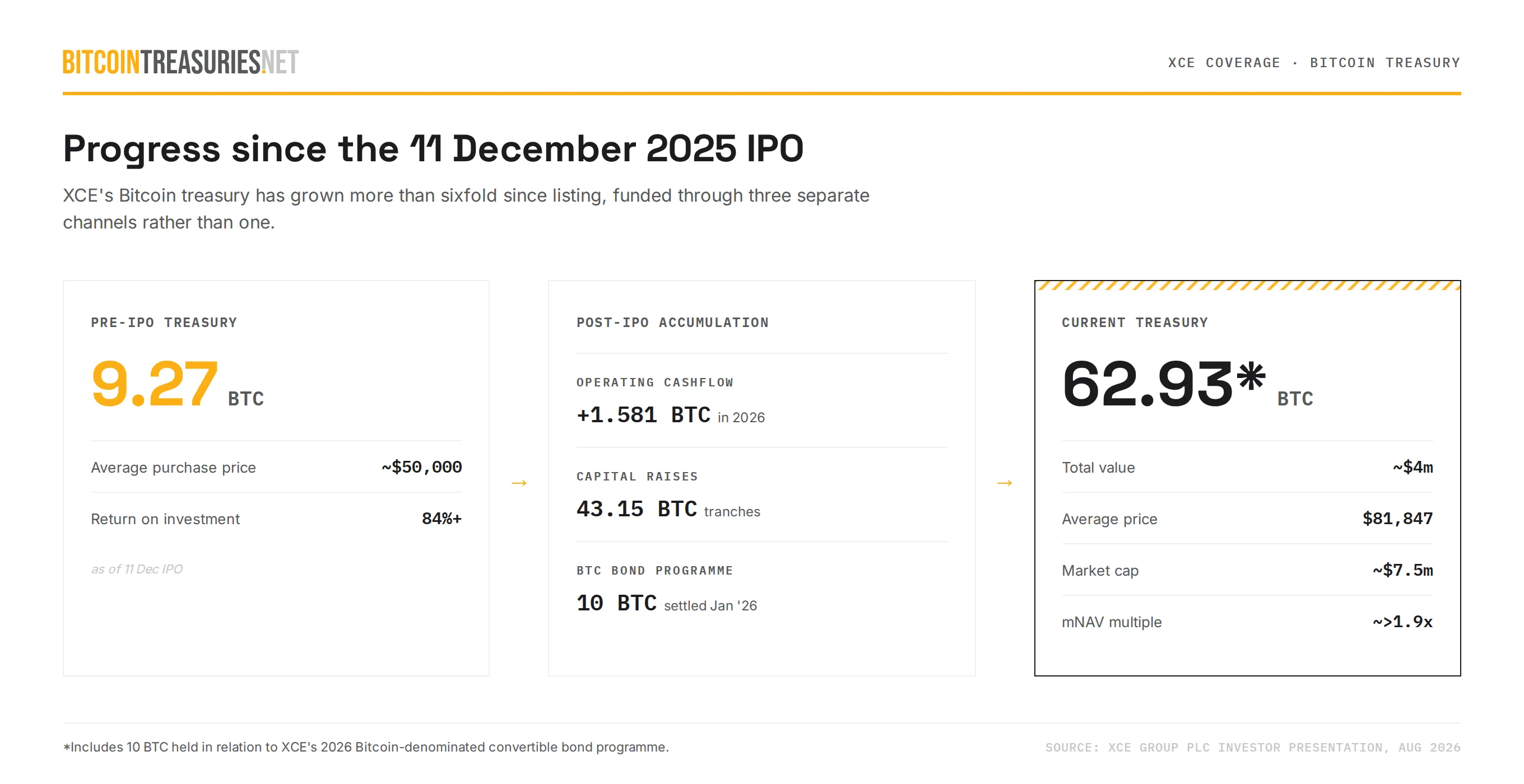
XCE's own treasury progress since IPO is the clearest evidence of the model in motion. Pre-IPO, the group held 9.27 BTC at an average purchase price of around $50,000, a position it says was up more than 84 per cent by the 11 December IPO date. Since listing, the treasury has grown through three channels: operating cashflow, which contributed 1.581 BTC in 2026; capital raises, which added 43.15 BTC across several tranches; and a Bitcoin-denominated convertible bond programme, which settled 10 BTC in January 2026 against a 31 December 2025 issue. The current holding stands at 62.93 BTC (including the 10 BTC tied to the bond programme), valued at roughly $4m at an average price of $81,847, against a market capitalisation of approximately $7.5m and an mNAV multiple above 1.9 times.
Why 200 BTC is the number that matters
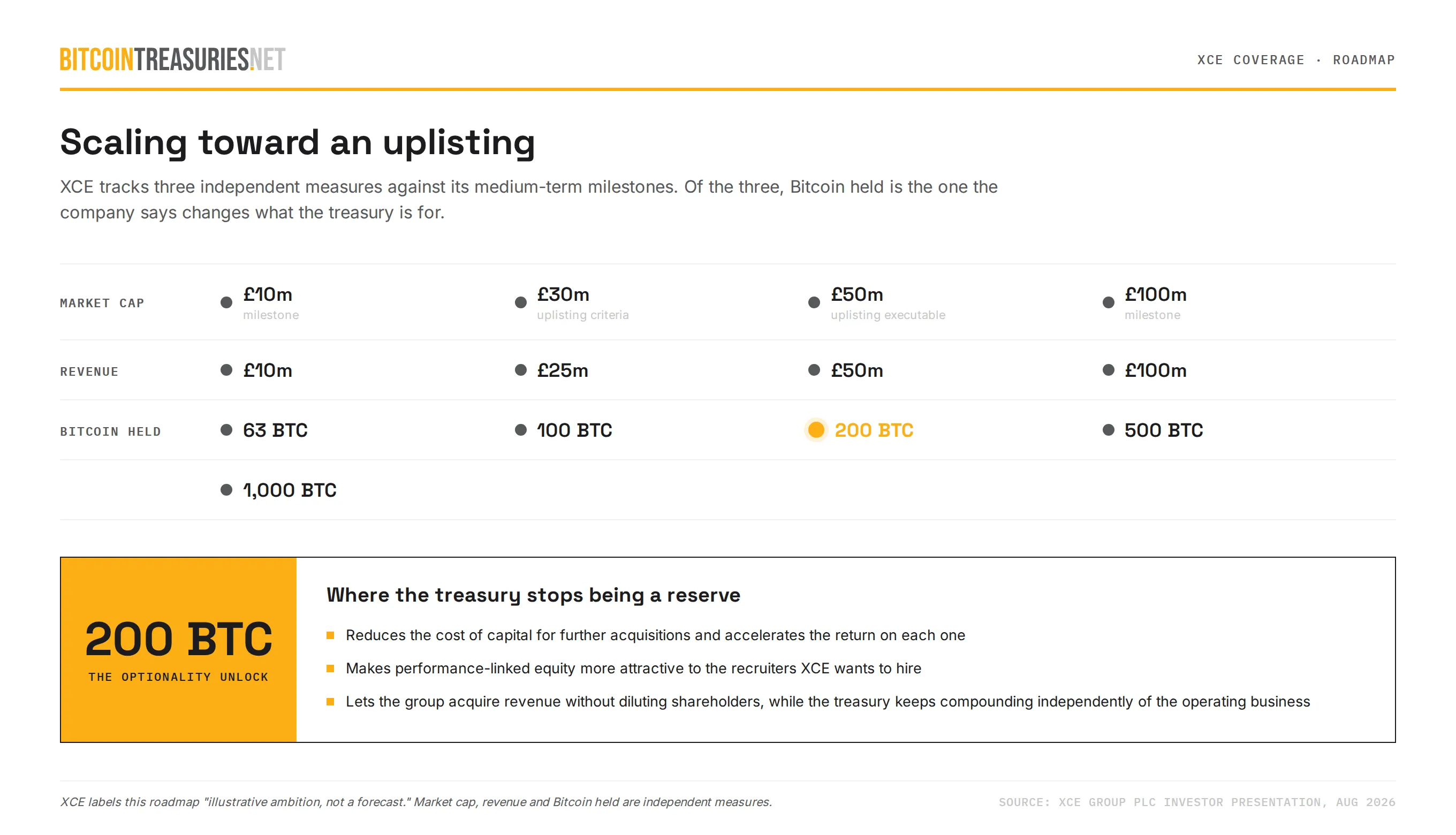
The company is explicit that market capitalisation, revenue, and Bitcoin held are separate, independent measures, and it frames its medium-term milestones (market cap progressing from £10m through an uplisting range of £30m-£50m to £100m; revenue from £10m to £100m; Bitcoin held from the current 63 through 100, 200, 500 and 1,000) as illustrative ambition rather than forecast. But of all those markers, XCE singles out 200 BTC as the one that changes the nature of the treasury. Below that level, the company frames Bitcoin holdings as a reserve. At around 200 BTC, XCE argues, the treasury becomes strategic optionality: a balance sheet strong enough to reduce the cost of capital for further acquisitions, make performance-linked equity more attractive to recruits, and let the group acquire revenue without diluting shareholders, all while the treasury keeps compounding independently of the operating business.
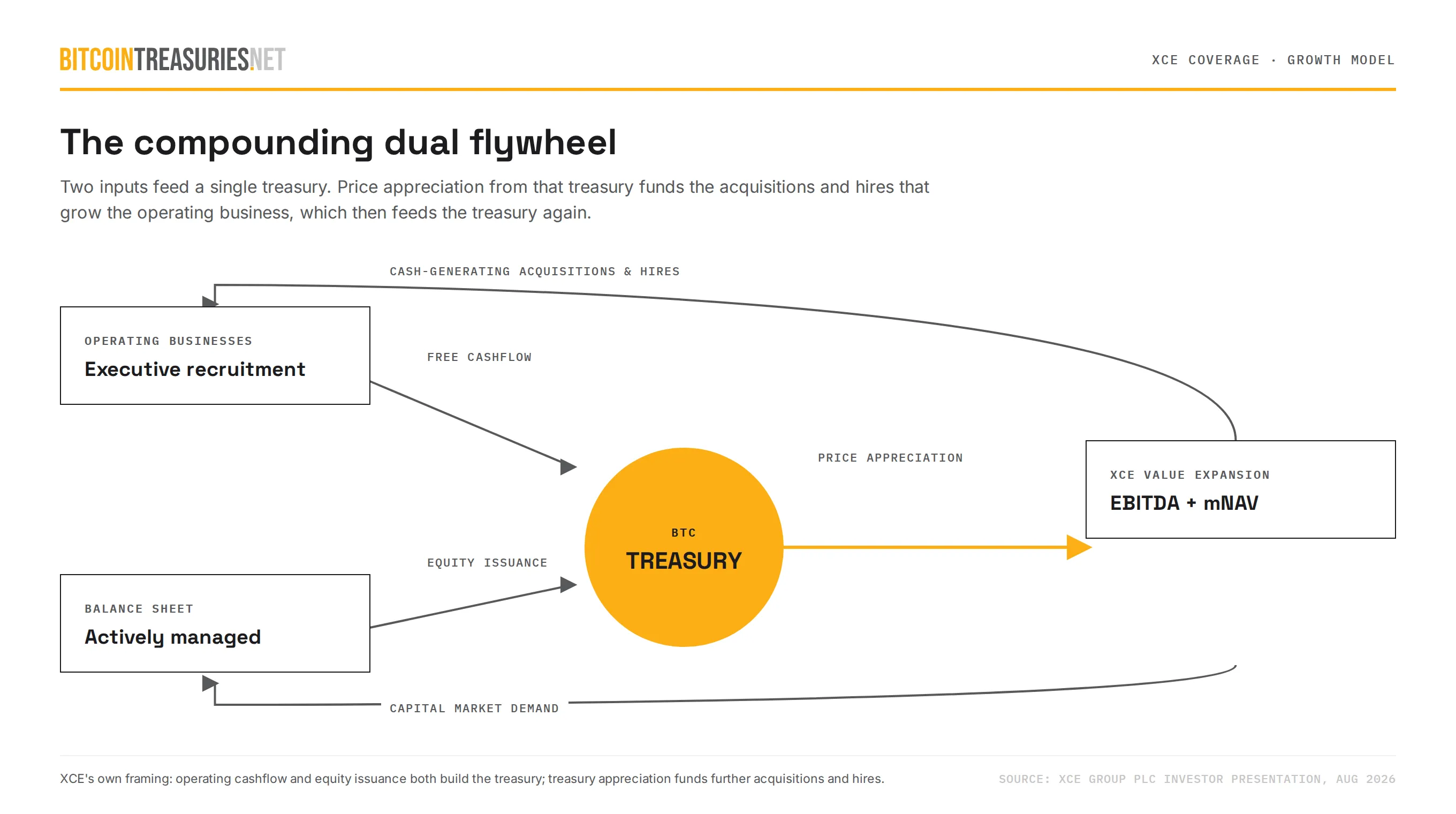
That is the throughline across the whole presentation, visualised in the company's own "compounding dual flywheel": free cashflow from the operating businesses and equity issuance from an actively managed balance sheet both feed the Bitcoin treasury; price appreciation from that treasury feeds XCE's value expansion, measured on EBITDA plus mNAV; and that value expansion, in turn, funds further cash-generating acquisitions and hires, which loop back into the operating businesses. XCE's stated rationale for holding Bitcoin at all leans on four points: preserving purchasing power on surplus capital rather than letting it sit in cash, growing operating earnings and Bitcoin per share together over time, maintaining a disciplined accumulation policy alongside continued investment in people and acquisitions, and treating Bitcoin as global, 24/7 collateral that gives the group optionality cash and property don't offer.
The backing behind the strategy
XCE's shareholder register reflects how closely the company is tied to Bitcoin-native capital. Adam Back, the cryptographer credited with inventing Hashcash, the proof-of-work system referenced in Satoshi Nakamoto's Bitcoin whitepaper, and co-founder and chief executive of Blockstream, holds approximately 22.9 per cent. Back is currently chief executive of the Bitcoin Standard Treasury Company, whose founders have set a target of 30,000 BTC, giving XCE a strategic investor who is simultaneously building a treasury vehicle in a different market. The board and advisory bench extends the theme: Richard Byworth, founder of Byz Partners and a former CEO of the first Nasdaq-listed digital asset company, sits as board advisor; Vijay Selvam, Chief Legal Officer at Tether-backed Elektron Mining, advises on digital asset regulation and governance; and Sam Roberts, formerly of Cartwright Pension Trusts, chairs the board as a non-executive with institutional Bitcoin allocation experience from the UK pension world.
The direction of travel
"The direction of travel is to build the world's only Bitcoin-powered executive recruitment firm," Ellam says. XCE's stated growth targets for future acquisitions and hires extend beyond recruitment into AI and data centres, digital assets, venture capital, private equity, investment banking and wealth management, each pitched as a route to senior-level mandates that carry high fees and, by the company's own account, attract Bitcoin-aligned investors and advisors. Every capital raise, XCE says, is designed to do three things at once: strengthen the Bitcoin treasury, increase revenue and profit, and expand the group's network.
The company's own line for it is that the larger the raise, the larger the increase.
What the deck ultimately describes is a company treating executive recruitment less as an end in itself than as the most efficient cash engine it could find for acquiring Bitcoin, then structuring every acquisition and every hire so that the treasury and the operating business grow in the same direction. Whether that flywheel keeps turning past 200 BTC and toward the milestones XCE has laid out will depend on execution the deck can describe but not guarantee.
Want more bitcoin treasury coverage in your search results? Add Bitcoin Treasuries as a preferred source on Google.